
From Planning to Permits: How Smart Families Move from Ideas to Execution in Boston
March momentum is powerful. Process discipline is what turns it into progress.
By Juan Wulff & Monica Gonzalez — 7-minute read
In March, Joe opened a spreadsheet—not Pinterest, not Zillow, but a spreadsheet. They had talked about remodeling all winter, the idea drifting in and out of conversation between school drop-offs, ski weekends, and late-night discussions at the kitchen counter. But March felt different. Bonuses had been posted, tax conversations had begun, and spring sports schedules were quickly filling the family calendar. As the long Boston winter started loosening its grip, a sense of momentum was building.
Looking over Joe’s shoulder, Liz said something simple: “If we’re serious, we need to understand what this actually involves.” That quiet shift—from dreaming to structuring—is where many remodeling projects either gain traction or stall. March has a way of turning ideas into questions, and questions into direction.
Who This Is For
This is for homeowners who feel ready to move beyond casual conversations. It’s for families who want to understand the real steps before construction begins, for those who prefer clarity before committing, and for people who value predictable outcomes more than fast starts. If you find yourself thinking, “We should probably start figuring this out,” this moment may be for you.
Why March Is a Strategic Window in Boston: Greater Boston tends to move in cycles. University calendars reset, research funding begins to flow, corporate budgets are refreshed, and families quietly start organizing their summer schedules. Construction follows similar rhythms. As spring approaches, design conversations that began casually during the winter months begin turning into real project pipelines. Architects and builders start mapping summer availability, permit volumes gradually increase across municipalities, and trade partners begin filling their calendars for the months ahead.
For homeowners, this seasonal shift creates an important window. Families who begin structured planning in March often position themselves for smoother execution later in the year, when schedules are clearer and decisions have been thoughtfully considered. Those who wait until early summer frequently encounter tighter timelines and fewer options. Momentum, after all, is valuable—but only when it is guided by a clear process.
Joe and Liz’s Planning Moment
Joe and Liz initially considered hiring a designer to “draw something up” before speaking with a builder. At first glance, the approach seemed logical: develop the vision first and figure out the construction details later. In Boston’s traditional, fragmented remodeling model, however, that sequence often introduces unnecessary friction. Designs can progress without real-time construction pricing, structural questions may surface only after drawings are complete, and permitting considerations sometimes appear later than expected. Budget conversations, instead of guiding the process, become reactive.
By the time a contractor enters the conversation, families may already feel emotionally invested in a design that no longer aligns with construction realities. What follows is often called “value engineering,” but at that stage it rarely feels strategic. To homeowners, it can feel more like compromise than thoughtful planning.
What an Integrated Design-Build Approach Changes
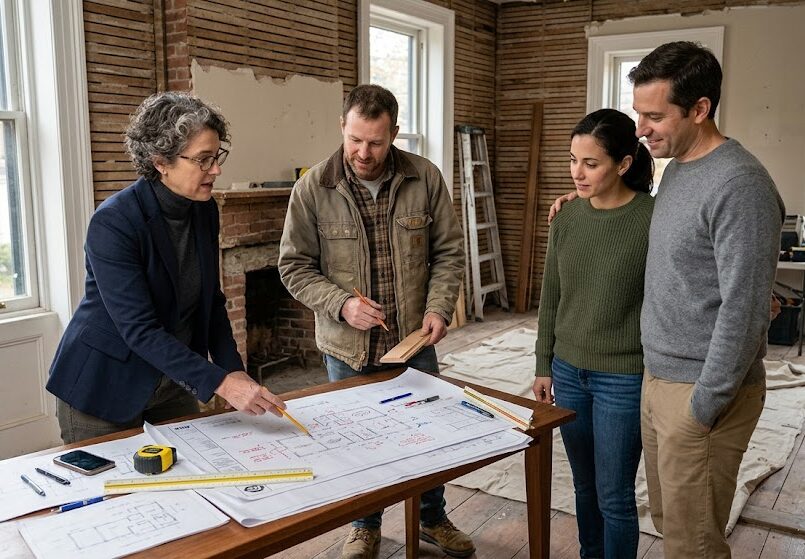
In a design-build process, execution thinking begins on day one. Before drawings advance too far, the conversation expands to include the practical realities that shape construction. Structural implications of layout changes are considered early, along with preliminary budget ranges tied to different scope options, likely permitting pathways within local municipalities, seasonal construction timing, and even material lead times. These factors help ground the design process in the conditions that will ultimately determine whether a project moves forward smoothly.
For Joe and Liz, this meant exploring several possible directions early in the process. One scenario kept the project within the existing footprint, another considered a targeted rear addition, and a third explored a phased approach over two years. Each option included rough budget modeling, structural feasibility considerations, and timeline implications. Instead of focusing on a single emotionally loaded idea, they were able to evaluate structured pathways. In that environment, clarity naturally replaced guesswork.
The Boston Reality of Early Planning
Greater Boston’s housing stock brings its own set of complexities. Many homes contain layers of renovations completed over decades, and it is common to discover hidden conditions once walls are opened. Historic district guidelines can influence exterior modifications, tight urban lots often require careful setback analysis, and seasonal factors—such as winter ground conditions—can affect foundation work and construction sequencing.
When these realities are overlooked during early planning, they frequently surface later as disruptions that affect both schedule and budget. Addressing them thoughtfully at the beginning of the process builds confidence and allows families to make decisions with a clearer understanding of what lies ahead. March offers something particularly valuable in this regard: time. It provides a window to study conditions calmly and plan deliberately, rather than reacting under the pressure that often arrives by mid-summer.
The Financial Layer of Execution
Planning is not only about design; it is also about financial clarity. Before moving forward, we encourage families to align three key considerations: their investment comfort range, their tolerance for contingency, and a clear understanding of how the project aligns with long-term property values within the neighborhood. When these elements are discussed early, they provide a stable framework for decision-making throughout the project.
Without this alignment, even well-designed projects can begin to feel uncertain once contracts are signed and real costs emerge. For Joe, the spreadsheet he opened in March gradually evolved from a simple wish list into something far more structured—a phased capital plan for the house. That shift, from vague ideas to financial clarity, reduced anxiety almost immediately and allowed the conversation to move forward with greater confidence.
Common Planning Missteps
Each spring we observe similar patterns among homeowners beginning the remodeling process. Many equate speed with efficiency, assume that separating design and pricing will save money, or underestimate the time required for permitting. Others believe that summer construction availability will always be there when they are ready to begin. These assumptions are understandable, but they often introduce avoidable complications later in the process.
March is not the moment to rush decisions. It is the moment to bring structure to the conversation—clarifying scope, timelines, and expectations so that momentum can move forward in a thoughtful and controlled way.
What Confidence Actually Looks Like
By late April, Joe and Liz had not yet begun demolition. What had changed, however, was their understanding of the path ahead. They now had a clear sense of the potential scope of their project, how the work would likely be sequenced, the approximate investment range, and how permitting and scheduling might unfold.
They had not rushed into construction. Instead, they had gained clarity. And that clarity is what ultimately allows families to move forward with confidence rather than uncertainty.
A March Reflection
St. Patrick’s Day in Boston is loud and celebratory, filling the city with music, color, and energy. Yet the deeper rhythm of March is quieter. It is the moment when possibility begins to turn into preparation, when conversations that started casually over the winter begin taking a more deliberate shape.
Homes tend to evolve best when planning matches momentum. A strong process does not slow families down; it simply provides the structure that allows progress to move forward with confidence and direction.
Considering a Remodel This Year?
If this spring feels like the right moment to move from casual conversations toward a more structured plan, it often helps to begin with process evaluation rather than finish selections. A disciplined design-build framework allows families to explore feasibility, align budgets, and anticipate Boston-specific constraints before construction ever begins.
That preparation creates confidence. And when homeowners move forward with clarity instead of uncertainty, the decisions that follow tend to be stronger, more thoughtful, and far more durable over time.
About A1RE
A1RE is a Greater Boston design-build firm founded by Juan Wulff, an engineer and construction expert, and Monica Gonzalez, a design and real estate strategist.
We integrate construction intelligence, design clarity, and property strategy to guide families from planning through execution with confidence.
Call us at 508-960-9603 or book a consultation today with our team.