
Demolition Day: Chaos or Celebration in a Remodel?
When Demolition Becomes a Celebration in Your Remodel
By Juan Wulff & Monica Gonzalez — 7-minute read
On a cold March morning in Greater Boston, the first dumpster arrives.
For many homeowners, this moment feels unsettling. Walls will come down. Dust will spread. Familiar spaces will look worse before they begin to look better. It can feel like a point of no return.
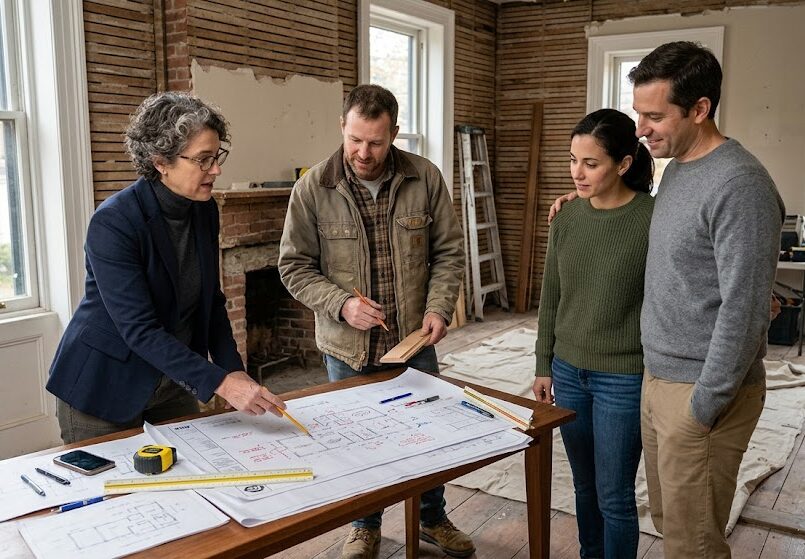
But when a project has been thoughtfully planned, Demolition Day is not a moment of loss. It is a moment of commitment, the start of a visualization. It is the day when months of conversations, drawings, and decisions begin to take physical form.
It is, in many ways, a quiet celebration.
The Emotional Shift from Planning to Reality
Planning lives in drawings, spreadsheets, and late-night conversations at the kitchen table. Construction lives in noise, motion, and visible change. The transition between the two can feel abrupt.
This is where many remodeling experiences begin to diverge.
In fragmented projects, demolition often introduces uncertainty. Unexpected conditions surface. Decisions are revisited under pressure. The energy shifts from excitement to anxiety.
But in a well-coordinated design-build process, demolition is not the start of chaos. It is the validation of preparation.
Every wall that opens confirms an assumption. Every discovery becomes a checkpoint rather than a disruption. The project moves forward with intention, not reaction.
Why Demolition Can Feel So Intense
Early construction is visually dramatic. Exposed framing, temporary lighting, protective barriers, and controlled dust transform the home into something unfamiliar.
In Greater Boston’s older housing stock, this phase carries additional complexity. Hidden layers from decades of prior renovations often emerge. Structural realities reveal themselves. Weather and inspection schedules influence timing.
Yet intensity does not have to translate into stress.
When leadership, communication, and planning align, the house may look unfinished — but the process feels grounded.
That distinction matters more than most homeowners expect.
The Difference Between Destruction and Transformation
Demolition is often misunderstood as an act of force. In reality, it is an act of exposure.
It reveals how the home was built. It shows where past decisions shaped the present. It creates the conditions for something new to emerge.
For families, this moment can be surprisingly emotional. It marks the beginning of a transformation that has lived in imagination for months or years.
A kitchen becomes an open gathering space. An underused attic becomes a bright living area. A fragmented layout begins to resolve into something intentional.
This is not simply construction. It is the physical expression of a decision to invest in the future of the home.
When Preparation Meets Execution
In one recent Boston-area project, the first week of demolition confirmed a structural condition we had anticipated during design: an undersized joist span from a prior renovation.
Because the possibility had been identified early, the reinforcement strategy was already defined. There was no panic. No redesign. No interruption to the broader vision.
What could have felt like a setback instead reinforced confidence in the process.
This is what thoughtful preparation looks like once construction begins. It transforms uncertainty into progress.
A Milestone Worth Recognizing
Demolition Day is often described as a beginning. But it is more accurate to see it as a milestone — the point where intention becomes irreversible.
When homeowners feel supported, informed, and aligned with their project team, this day carries a sense of momentum rather than fear.
It is the first visible step toward a more functional, more beautiful, and more valuable home.
It is the moment when an idea stops being theoretical and starts becoming real.
Considering a Remodel in Greater Boston?
If you are planning a remodel this year, look beyond the design phase alone. The true test of a project is how planning translates into execution.
Demolition should not feel like a leap into the unknown. It should feel like the start of a carefully guided transformation.
At A1RE, we believe that when preparation and construction are fully integrated, even the most disruptive phases of a remodel can feel purposeful — and, at times, quietly celebratory.
Call us at 508-960-9603 or book a consultation today with our team.