
The Discipline Behind the Finish Line: Why Process Wins in Boston Remodeling
Marathon energy is visible in April. The real advantage is built in the months before.
By Juan Wulff & Monica Gonzalez — 7-minute read
On Marathon Monday, the crowd sees grit in motion. They see runners crest Heartbreak Hill, they see finishing times flashing, they see medals being placed around necks in a blur of emotion and relief. What they do not see are the quiet, unremarkable months that made those moments possible—the 5:00 a.m. training runs in February, the mileage logged in freezing rain, the disciplined pacing strategy that kept everything on track when fatigue set in.
Remodeling in Greater Boston follows the same pattern. Homeowners see the finished kitchen, the new addition, the polished details that feel inevitable once complete. What they don’t see is the structural modeling that happened long before demolition, the budget calibration that defined what was possible, the permit sequencing that shaped timing, or the coordination meetings that aligned trades before a single wall came down.
In both cases, the visible result is only the final expression of an invisible system. The discipline is what carries everything to the finish line.
Insight: In remodeling, just like endurance training, the visible result reflects the discipline of the system behind it.
Who This Is For
This is for homeowners who care less about surface outcomes and more about how decisions are made along the way. For those who want fewer surprises, clearer expectations, and a process that replaces improvisation with structure.
It’s for people who understand that a home project is not just about what gets built, but how confidently it gets built. If you value preparation as much as outcome—and you believe good results are engineered, not improvised—this perspective will feel familiar.
April Energy Can Be Misleading
April in Boston has a particular intensity. The city comes alive, schedules accelerate, and construction season suddenly feels urgent. There is momentum everywhere, and it can create the impression that action alone produces progress.
But momentum without coordination is not the same as progress.
Starting quickly without alignment often feels productive at first, yet it tends to create friction later. In remodeling, that friction shows up in predictable ways: budget stress that wasn’t anticipated, timelines that quietly drift, design decisions that need to be revisited midstream, and the emotional exhaustion that comes from constant adjustment.
The goal is not speed for its own sake. The goal is structured momentum—movement that is steady, informed, and prepared for what comes next.
Joe and Liz’s “Training Plan”
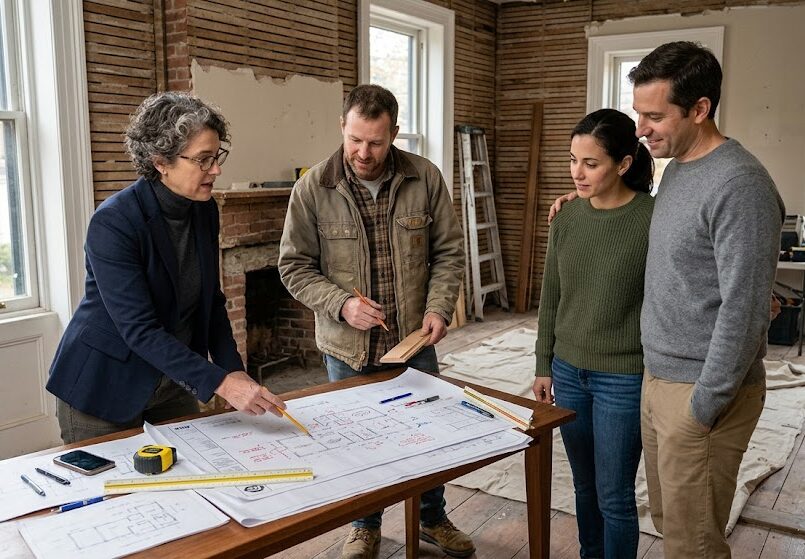
By April, Joe and Liz’s neighbors assumed their remodel was just beginning. From the outside, it looked like a spring project coming to life with fresh permits and visible construction activity.
In reality, the most important work had already been completed.
Before any permit was pulled, the project had already gone through structural modeling to understand what removing walls would require. Budget ranges were built in tiers to reflect different scope possibilities, giving clarity instead of guesswork. Potential permit pathways were mapped in advance so approvals would not become delays. Construction was sequenced around seasonal inspections, and material lead times were aligned with framing schedules to prevent downstream pauses.
None of this was dramatic. It was deliberate, quiet, and methodical.
So when inspections arrived, they passed cleanly. When framing began, structural reinforcement was already accounted for in both pricing and planning. What looked like “momentum” in April was actually the outcome of disciplined preparation in February and March.
The progress was visible only because the system behind it had already done its work.
Where the Traditional Model Breaks Down
In a fragmented remodeling model, the equivalent of training and race day are disconnected. Design is completed in isolation, contractors are brought in later to price what has already been drawn, and structural analysis is often forced to follow aesthetic decisions rather than inform them.
Budget alignment becomes reactive instead of intentional. And once construction begins, friction is almost inevitable.
That friction appears as value engineering that feels like compromise, schedule shifts that feel unexpected, and decisions that need to be revisited under pressure. Over time, trust erodes—not because of one major failure, but because the system never anticipated complexity in the first place.
No one planned for confusion. The process simply allowed it to happen.
What Design-Build Intelligence Actually Means
Design-build is often misunderstood as a matter of convenience. In reality, it is about integration.
At A1RE, engineering evaluation, design strategy, budget modeling, and construction sequencing are not separated into phases that talk to each other later—they are aligned from the beginning.
That alignment allows for early identification of structural risk, transparent cost expectations, realistic scheduling, and coordinated trade mobilization before construction begins. Instead of reacting to issues as they arise, the process anticipates them during design.
That anticipation is not a detail. It is the advantage.
Boston-Specific Coordination Matters
Greater Boston homes rarely offer simplicity. Historic framing methods often require thoughtful reinforcement. Municipal permitting varies from town to town, each with its own expectations and timelines. Urban sites demand careful staging, and spring inspection calendars fill quickly as construction season ramps up.
Without early coordination, April momentum can quickly turn into bottlenecks.
With integrated planning, those same conditions become manageable variables rather than disruptions. Process intelligence absorbs complexity instead of being derailed by it.
Common Misconceptions About Remodeling Process
Many remodeling challenges come not from execution, but from assumptions about how the process works.
That once drawings are complete, everything becomes predictable. That bidding projects out always reduces cost. That speed is inherently efficient. That change orders are simply unavoidable.
In practice, predictability comes from integration, not completion. Cost control comes from early modeling, not late comparison. Efficiency comes from sequencing, not acceleration. And many change orders are not inevitable—they are the result of decisions made too late in the process.
The finish line does not reward urgency. It rewards discipline.
The Emotional Payoff of Structure
When the process is structured, homeowners experience something that is often overlooked in remodeling discussions: steadiness.
They understand what decisions are coming next. They see how costs are shaped. They know how schedules respond to weather or inspections. They can anticipate contingencies instead of reacting to them.
That clarity reduces stress more effectively than any design feature ever could.
And in a city that celebrates endurance every April, that kind of steadiness becomes its own quiet form of confidence.
A Patriot’s Day Reflection
Patriot’s Day is not defined by spectacle. It is defined by preparation, endurance, and resolve—the kind that rarely draws attention but determines outcomes.
Remodeling deserves the same understanding.
The homes that feel effortless during summer gatherings are not the result of a single moment of inspiration. They are shaped by months of structured thinking before the first nail is driven, before the first wall is opened, before anything becomes visible at all.
The medal is what people see. The training is what made it possible.
Considering a Remodel This Spring?
If April energy has you thinking about starting a project, the most important question is not just what you want to build—but how it will be built.
An integrated design-build approach aligns engineering, budgeting, permitting, and construction sequencing from the beginning, ensuring that decisions support one another instead of competing later.
In Greater Boston, that coordination is not a luxury. It is what carries a project cleanly across the finish line.
About A1RE
A1RE is a Greater Boston design-build firm founded by Juan Wulff, Engineer and Construction expert, and Monica Gonzalez, Design and Real Estate strategist.
We combine engineering rigor, design clarity, and property strategy to deliver projects built on preparation — and finished with confidence.
Call us at 508-960-9603 or book a consultation today with our team.