
What the Boston Marathon Teaches Us About Designing a Family Home
The visible result is one day. The real work happens in the months before.
By Juan Wulff & Monica Gonzalez — 7-minute read
On Marathon Monday, Boston feels electric.
Barriers line the streets as the city transforms into a long corridor of anticipation. Families gather hours early to claim their spots, bundled against the lingering chill of spring. Runners move through the city in waves—focused, disciplined, and visibly carrying the weight of months of preparation.
For spectators, Marathon Monday feels like a single, powerful day. But for runners, it is only the final expression of a long, quiet process that no one sees: early mornings, incremental progress, and disciplined consistency. The race is not the beginning of effort—it is the outcome of it.
Most family homes are evaluated the same way people experience race day. Guests notice the finished kitchen. Friends admire the open floor plan. Neighbors register the new addition or refreshed exterior. What they see is the result. What they do not see is what determines whether daily life feels smooth or strained.
The truth is simple: the homes that feel effortless are not accidental. They are the result of disciplined preparation, not aesthetic momentum.
Who This Is For
This is for families who are entering a new stage of growth and want to approach their home intentionally rather than reactively. It is for those who understand that meaningful outcomes require planning, not improvisation. And it is for people who prefer stability over spectacle—homes that support life quietly, consistently, and over time.
If you believe that preparation shapes outcomes, this perspective is for you.
April Energy in Greater Boston
April changes the rhythm of the city in noticeable ways. The Boston Marathon brings endurance into public view, turning personal discipline into something collective. Patriot’s Day reinforces a cultural memory of resilience. Even the light shifts—longer days and clearer skies revealing details that winter had kept hidden.
Inside homes, energy rises as well. Windows open again. Schedules expand. Backyards re-enter daily life. With that shift often comes the urge to improve the home—quickly, while motivation feels high.
But April enthusiasm can easily lead to reactive decisions:
“We should open this wall.”
“Let’s add a deck before summer.”
“Maybe we just expand the kitchen quickly.”
Energy is powerful in this season. Direction is what determines whether it leads to clarity or complication.
Joe and Liz’s “Race Day” Mindset
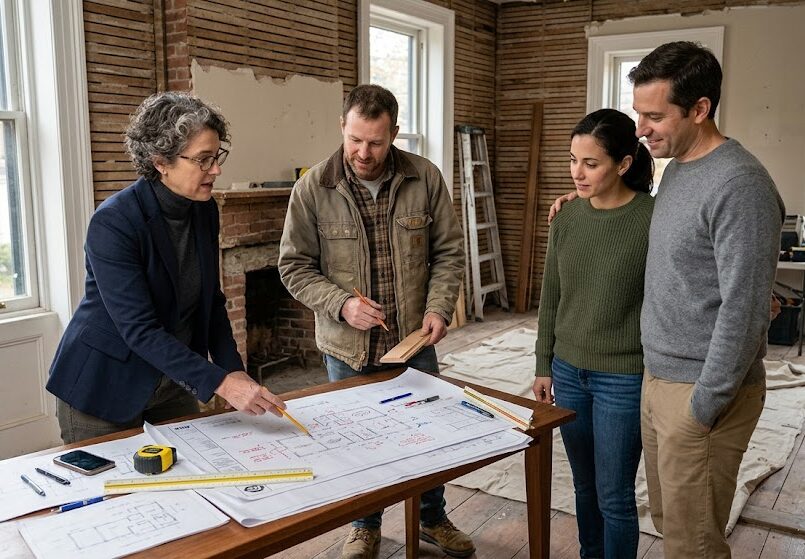
By April, Joe and Liz were not just thinking about their project—they were already inside it. Design planning had been completed. Permits were in motion. Structural drawings were finalized. Trade schedules had been coordinated with care. From the outside, it may have looked like they were just beginning.
In reality, they had spent months preparing. They studied layout options in detail, modeled investment scenarios, and walked through how their daily routines would actually function in the new space.
So when construction finally began, it did not feel chaotic. It did not feel rushed or uncertain. It felt earned—because the work had already been done long before the first wall came down.
Designing for Endurance, Not Applause
In Greater Boston’s older housing stock, it is easy to chase cosmetic momentum. A refreshed surface can feel like progress, but surface changes alone rarely resolve deeper functional strain.
True alignment requires a different kind of thinking. It begins with questions that rarely appear in design inspiration feeds:
“How will this space perform in five winters?”
“Does the layout support mornings under pressure?”
“Can two generations move through this home comfortably at the same time?”
“Is storage integrated into the structure or added as an afterthought?”
These decisions do not always produce dramatic before-and-after photos. Instead, they produce something more valuable: daily calm.
Remodeling is often misunderstood as the pursuit of a moment. In reality, it is the process of building stamina into a home so it can support life as it evolves.
The Boston Reality Behind the Walls
Every April, the excitement of new ideas meets the reality of constraints. Historic overlays shape what exterior changes are possible. Lot lines define expansion limits. Existing structural systems determine what can realistically be supported. At the same time, seasonal construction schedules tighten as demand increases.
Without preparation, enthusiasm can collide with these realities in frustrating ways. With preparation, however, those same constraints become design parameters—clear boundaries that guide better decisions.
This is where the difference emerges between sprinting and training. One reacts to conditions. The other is shaped by them.
What We See Every Spring
Each April, families come to us with ideas inspired by the season. Some are already prepared. Others are reacting to momentum.
The prepared families have already clarified their goals, aligned their budgets, anticipated upcoming life changes, and discussed realistic timelines. They approach remodeling like training for a long-distance event—structured, intentional, and paced.
The reactive families often approach it like a race they suddenly realized they are in. The energy is high, but the direction is unclear. The experience feels very different as a result.
Common Missteps During High-Energy Months
In moments of seasonal enthusiasm, certain patterns repeat themselves: starting demolition before design clarity is achieved, making layout decisions based on short-lived trends, underestimating permit timelines during peak demand, or prioritizing visual impact over structural integrity.
April energy should not be suppressed—it should be directed. The difference lies in whether it fuels planning or replaces it.
A Quiet Easter Parallel
Easter often symbolizes renewal, but renewal is rarely immediate. It is the result of processes that begin long before they are visible. Gardens do not bloom because of a single warm day—they bloom because of soil preparation, timing, and consistent conditions established earlier.
Homes operate in much the same way. What feels like transformation is usually the visible expression of earlier discipline.
Closing Reflection
Boston celebrates endurance in public every April through its most iconic events: the Marathon, Patriot’s Day, and the collective memory of a city that shows up year after year.
Homes benefit from the same philosophy. The most successful remodels are not sudden bursts of inspiration. They are the outcome of steady, coordinated effort that happens long before construction begins.
Like training for a race, the work done in advance determines how strong and steady the finish will feel.
Considering a Remodel This Spring?
If April energy has sparked new ideas, the most important step is not acting quickly—it is shaping those ideas into a clear, grounded plan. A thoughtful design-build process channels momentum into preparation, aligning lifestyle needs, structural realities, and long-term goals before construction begins.
Endurance is not dramatic. It is deliberate.
About A1RE
A1RE is a Greater Boston design-build firm founded by Juan Wulff, Engineer and Construction expert, and Monica Gonzalez, Design and Real Estate strategist.
We integrate engineering discipline, design clarity, and real estate insight to create homes built for long-term family life in Greater Boston.
Call us at 508-960-9603 or book a consultation today with our team.